
Now, who are the owners of monetary assets and who are the debtors? Statistics distinguish three sectors: the state, enterprises and private households. In this graph the relation is expressed in per cent of the Gross Domestic Product.
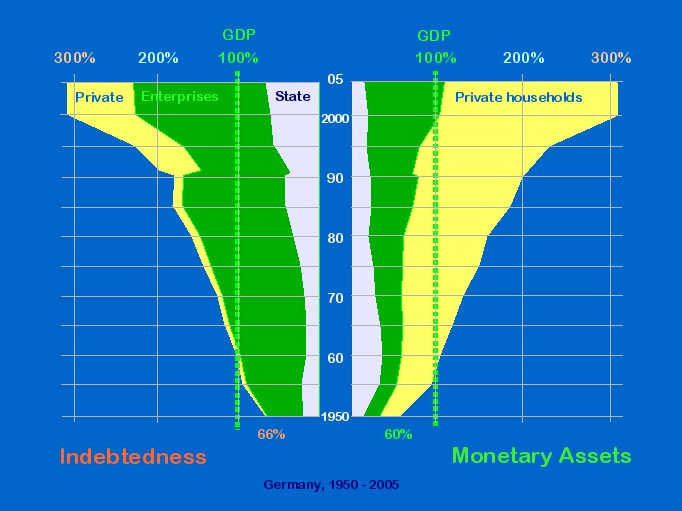
The state is the biggest individual debtor in the economy, but it is not the only debtor. In the first decade after the war, the state managed to build up a considerable fortune on the right side while keeping the indebtedness on a rather low and even decreasing level.The state which had about one third of all assets in the beginning, has become poorer and poorer since 1960 and since the 70ies, debts are continuously on the rise. Today the state holds only about 6% of the total of assets.
The second sector concerns enterprises. While enterprises had built up higher assets, the indebtedness developed much faster. If money was hoarded it would disrupt the circulation and cause gaps in the supply-and-demand-cycle. Therefore, monetary savings have to be fed back into the economy via loans, otherwise the economy would be jeopardized by a deflationary recession. However, due to the mathematical law of compound interest monetary assets and debts must grow. And if the state refrains from making debts, then someone else has to shoulder the burden. The increase of indebtedness of the enterprise sector was particularly strong between 1991 and 2005.
The largest increase in monetary assets on the other side had the private households which now hold 2/3rds of all assets. In principle this would be appropriate because private households stand for those who work and have a rightful claim for the biggest share. By the way, the apparent sudden jump of private indebtedness since 1991 was not caused by a dramatic event in the economy but is only due to a different method of processing statistical data.