
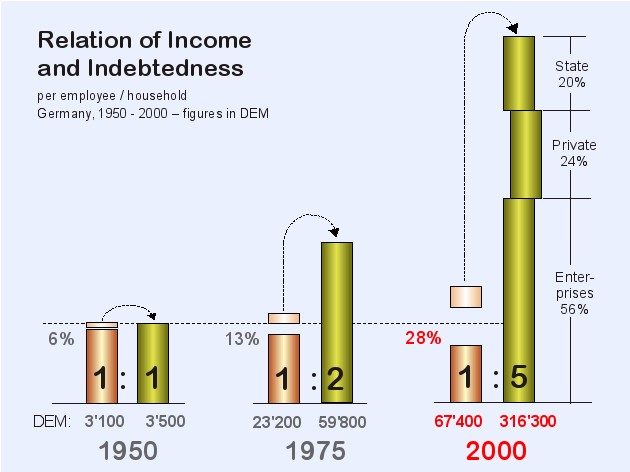
In order to make it more comprehensible what this means for an individual participant in the economy, we can divide the sum of all debts by the number of participants and compare this share with his annual, disposable income.
The income columns for the given three years are kept equally high, although the absolute figures are quite different. They are given below the respective columns. In this way, the ratio between income and debt share can be compared.
It has to be mentioned here, that these figures can be backed by respective data. In fact however, the interest share in prices is higher, because interest for the entrepreneur’s own capital, especially tangible capital, is not included. This can only be estimated since no reliable statistical data are available.Today, we can assume an interest share in prices of about 40-45%. Of course these are average figures. Depending on the kind of produce or service, these shares can differ within a broad range. They are very low in services that do not require much capital and they are very high in rents for real estate and in produces from processed mineral oil for instance, where the interest share can amount up to 70% and more. Well, everybody is delighted about getting interests credited on his or her savings account at the bank. But no one seems to ponder about the question, where those interest payments come from.