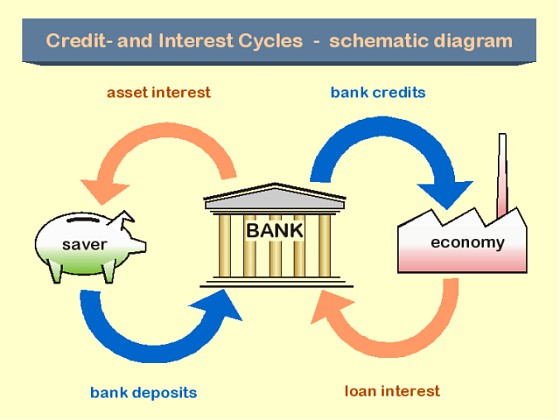
The largest part of savings deposited in banks is lent out to enterprises in the economy and another large part to the state. The debtor pays interest to the bank and after deduction of the bank margin it credits this interest on the savings account of the creditor. However, the interest revenues of the creditor, come from some debtors who have to earn the interest. Every entrepreneur calculates the prices for his products on the basis of all his costs for staff, raw material, maintenance of machines, rent for ground and buildings a.s.o. – and the costs of borrowed capital! The entrepreneur has to collect the amount of his costs through the price of his produce. In the end it is the consumer who has to pay for all these costs. And the vast majority of consumers have to work for it and thus they also work for the servicing of debts that are not their own. Hence, the assumption that we are only paying interests for our own loans is a misconception.
Everyone pays an interest share of about 40-45% with every spent Euro, on the other hand most people receive interest returns through their own savings. The distribution of interest payments depends on expenditures. The revenues from the interest pool, from where the money flows back, depend on the fortune that one possesses and they concentrate on a minority.
Pages: 1 2 3 4 5 6 7 8 9 10 11 12 13 14 15 16 17 18 19 20 21 22