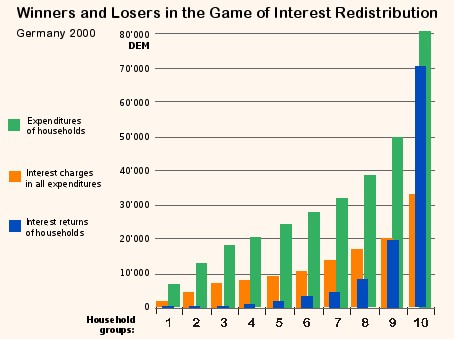
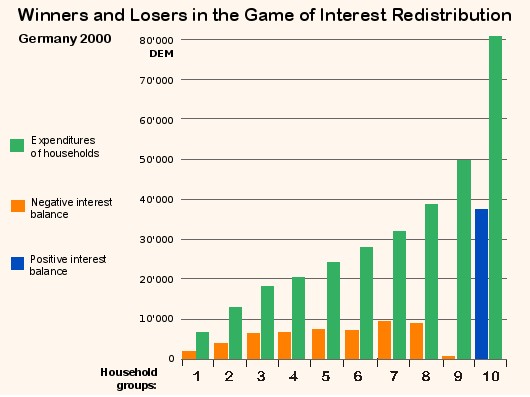
The question arises now who is winner and who is loser in this game of interest redistribution, because dividing macro-economic figures by the number of households gives an average idea only which may be far away from individual experience. In order to get a more differentiated picture the number of total households was divided into ten groups of 3.8 million households each. Group 1 comprises the poorest households with the lowest income and no or very little property and group 10 encompasses the richest households. The
green columns show the expenditures for consumption that the members of the various groups can afford from their disposable income. The
orange columns represent the interest share with an estimated proportion in prices of 40% in this graph. The
blue columns, finally, represent the interest returns in the various groups of households.
Drawing the balance between interest payments and interest returns shows that the first eight groups have a negative balance – they pay more than they get back. In the nineth group payments and returns are almost even, they are neither losers nor are they winners in the game. The big winners are found in the tenth group where the losses of the first eight groups turn into profits. The surplus in this group, the balance of interest payments and revenues, corresponds to the losses of the majority of the population. Or expressed in concrete terms, there is a continuous net flow of interest payments from the majority of the population to a small minority, which already possesses a large fortune.
Pages: 1 2 3 4 5 6 7 8 9 10 11 12 13 14 15 16 17 18 19 20 21 22