
Let’s turn to the question how unemployment is affected by interest burdens. Here is the curve of interest revenues and their various ascending phases. The yellow curve represents them in absolute figures, the red line reflects their ratio to the Gross Domestic Product, the economic output.
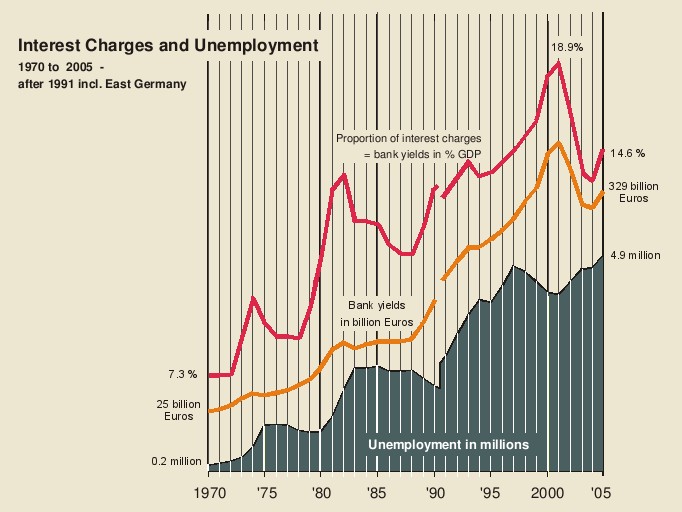
Since the growth of the economic performance slows down with increasing interest charges their proportion shoots up, and they rapidly decline when interest rates decrease. The proportion of interest charges shows the scope of the economy. We also observe that the proportion of interest charges goes on to increase after a short decline. This is the consequence of the fact, that the advantage of increasing interest returns will be swallowed by excessively rising debts. While this advantage had a positive effect during the first decade after the war which even contributed to a gradual elimination of unemployment, this is not so any more. Today unemployment increases and could only be reduced for short periods by cuts in wages. The cake can be divided only once and if the monetary capital and with it the burden of debt interests grows faster than the economic output, then the other side will receive a corresponding smaller share.
The state, which was able to finance the social net and support the unemployeds is increasingly uncapable of doing so. For one thing, because its revenues drop when companies go bankrupt or have lower turnovers, on the other hand, because the increasing number of unemployeds and growing social tensions cause higher costs. These costs are not bearable any longer and an attempt has to be made to reduce these costs, because they are nagging on the reserves.