
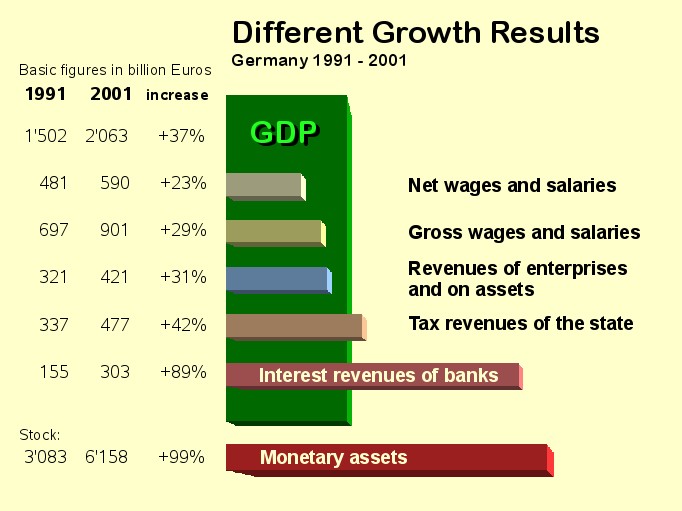
But what happened? Firstly, net wages have grown only 23%. Gross wages, too, remained one fifth below the measure. Even incomes from entrepreneurial activity and from fortunes were lagging behind, which reflects the precarious situation of enterprises. They fight difficulties and their fears of bankruptcy. And many do go bankrupt.
Only the state could slightly increase its revenues above proportion. But what goes beyond any scope are the interest revenues of banks with 89% and along with them the augmentation of monetary assets by 99%. That means a doubling of monetary assets within ten years. This might be seen as a slight slowing down of their growth, because the average in the previous decades was a doubling of monetary assets every 8 to 9 years.
The insane augmentation of monetary assets can only be stopped, if the holding of money can be prevented. This is also a question of the juridical assessment of money. Primarily it is a public medium for exchanging goods and services by steady circulation, a public institution which should be open for usage by everyone and must not be blocked by anyone. Regarding money as a private commodity and keeping it as one likes could be compared to a driver who parks his car as he likes in the middle of a road, thus obstructing the ongoing traffic. Unlike the car driver, who would receive a severe penalty for his inappropriate behaviour, the money holder is seduced by a reward to feed his money back into circulation. Money is the most important medium in the economy which enables and sustains the exchange of services and goods. But still today, anyone has the right to block the flow of money without being made liable for the damage to the economy.