
The picture of this gear mechanism might be useful for summarizing the whole situation. The left part shows the cycle in the monetary sector and the right side is divided into an upper and a lower semi-circle representing the real economy.
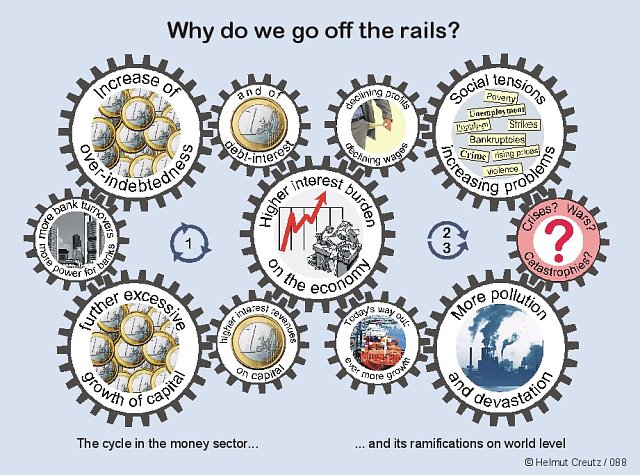
In the money sector, monetary assets over-proportionally grow with an annual growth rate of 7-8% and the bank towers in every metropolis around the world grow higher and higher. The mass of monetary assets accumulates there and has to be serviced. This requires a corresponding infrastructure. Consequence is the expansion of credits to the economy – consequences again are higher interest burdens which have to be worked for in the economy. The interest flows to monetary assets increase and monetary assets grow. This is the vicious circle which our monetary system is based upon.
The consequence is, that ever higher interest payments leave less for others. Wages and profits decline and their consequences are bankruptcies, poverty, unemployment, rising prices, strikes, violence – in short: growing social tensions. And when these build up, which is inevitable with continuous redistribution, the kettle will burst. Civil wars, revolts, general strikes or whatever might arise up to wars.
So far the way out of the dilemma was continuous economic growth. We have been trying to deal with these tensions by baking ever bigger cakes. But this way out through continuous economic growth is a dead end because of the finiteness of the earth and its resources. From this development, too, result growing tensions, which already led to conflicts of interests. The conflict arises about the rights over the last resources which are bound to become scarcer by time. This will not be solved without wars, as we have already witnessed at the gulf, and in the near future there will probably arise conflicts about drinking water.
Well, that is the situation now which from both sides runs in a disastrous direction. What can be done? How can the disaster be avoided?
This is possible in one point only: the compulsion for economic growth must be reduced. And this is only possible, when there is no need for expanding the economic performance. The social problems would ease off, if the need for economic growth was diminished and with it the need for continuously expanding the circulating money. This again is only possible, when interest rates could decline without triggering fatal problems. A safeguarding of money circulation that really works, could enable interest rates to drop to zero along and in accord with economic growth rates. The excessive growth of monetary assets would be reduced and with it the social tensions, which build up today not only between North and South but also within nations. With it the accelerated accumulation of debts would ease off and release the productive people in the economy from solving the impossible task of diminishing debts that grow faster than people can work.
Such a safeguarding measure could easily be implemented on current accounts or demand funds, where a demurrage fee of, say, half a per cent per month could easily be deducted. This would prevent the holding on to demand funds longer than actually needed. It is a bit more difficult with cash money, but there are a number of proposals of how this could be done. A circulation safeguarding or demurrage fee of that kind could stabilize the circulation of money in a similar way as the traffic, which is regulated with corresponding fees in order to avoid blockages.
Without this decisive measure and an amendment of the defect in the money system a fair world will not be possible. For, a fair world is possible only on a
fair foundation, and that is
a fair money.